Written on
Apostille of The Hague in Algeria: What Changes from 2026
Since July 9, 2026, the Apostille of The Hague simplifies document legalization between Spain and Algeria. Key points and benefits.
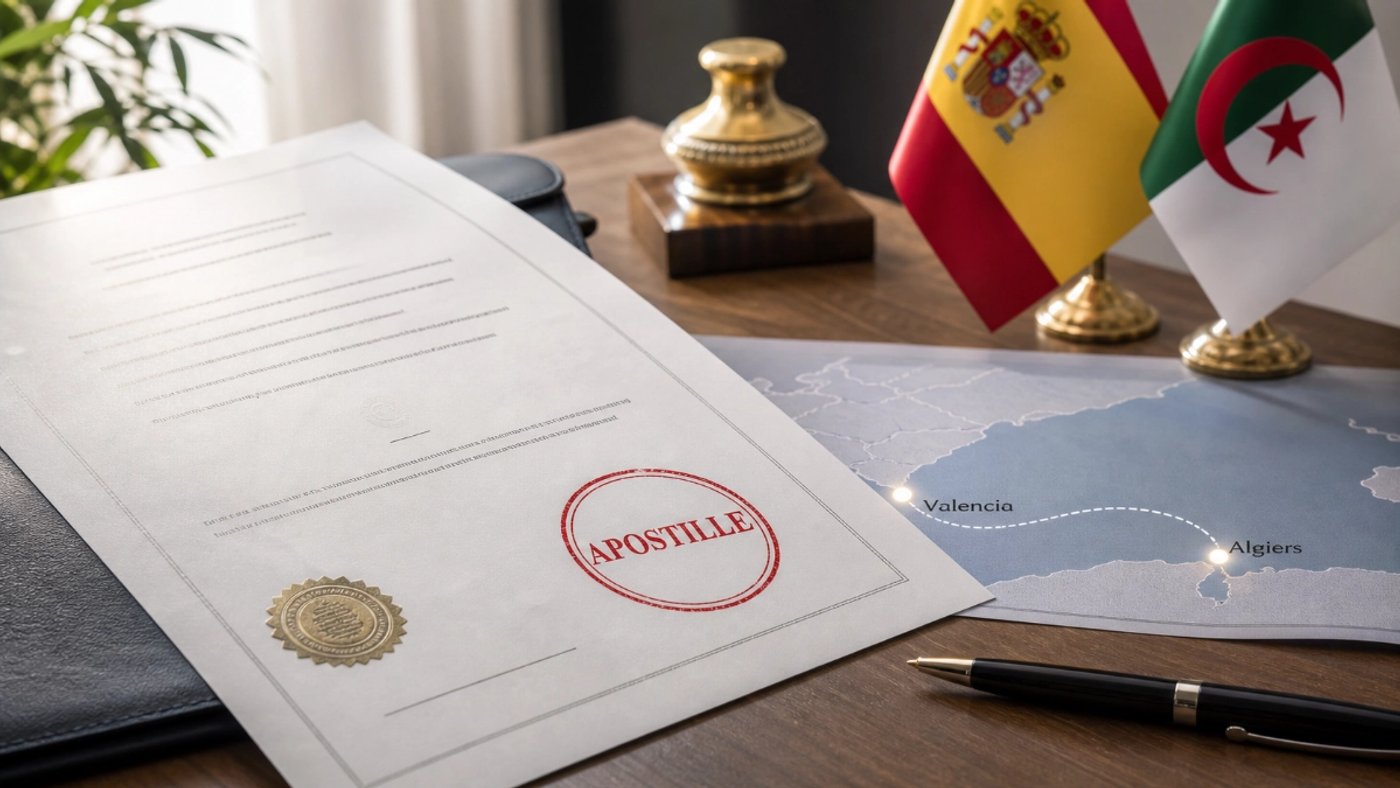
The Hague Apostille is now in force in Algeria: an important simplification for companies and individuals
Since 9 July 2026, public documents intended to circulate between Algeria, Spain and the other States bound by the Convention can benefit from a much simpler authentication procedure.
The Hague Convention of 5 October 1961 Abolishing the Requirement of Legalisation for Foreign Public Documents entered into force for Algeria on 9 July 2026.
Algeria’s effective incorporation into the international Apostille system represents a particularly relevant change for companies and individuals who need to submit Algerian documents in Spain or Spanish documents in Algeria.
Algeria deposited its instrument of accession on 5 November 2025. After the period provided for in the Convention was completed, the accession became fully effective on 9 July 2026.
What is the Hague Apostille?
The apostille is an official certification that makes it possible to verify the authenticity of a public document issued in one State so that it can be presented in another State bound by the Convention.
Specifically, the apostille certifies:
- The authenticity of the signature appearing on the document.
- The capacity or position in which the person signing the document acted.
- The identity of the seal or stamp attached to the document.
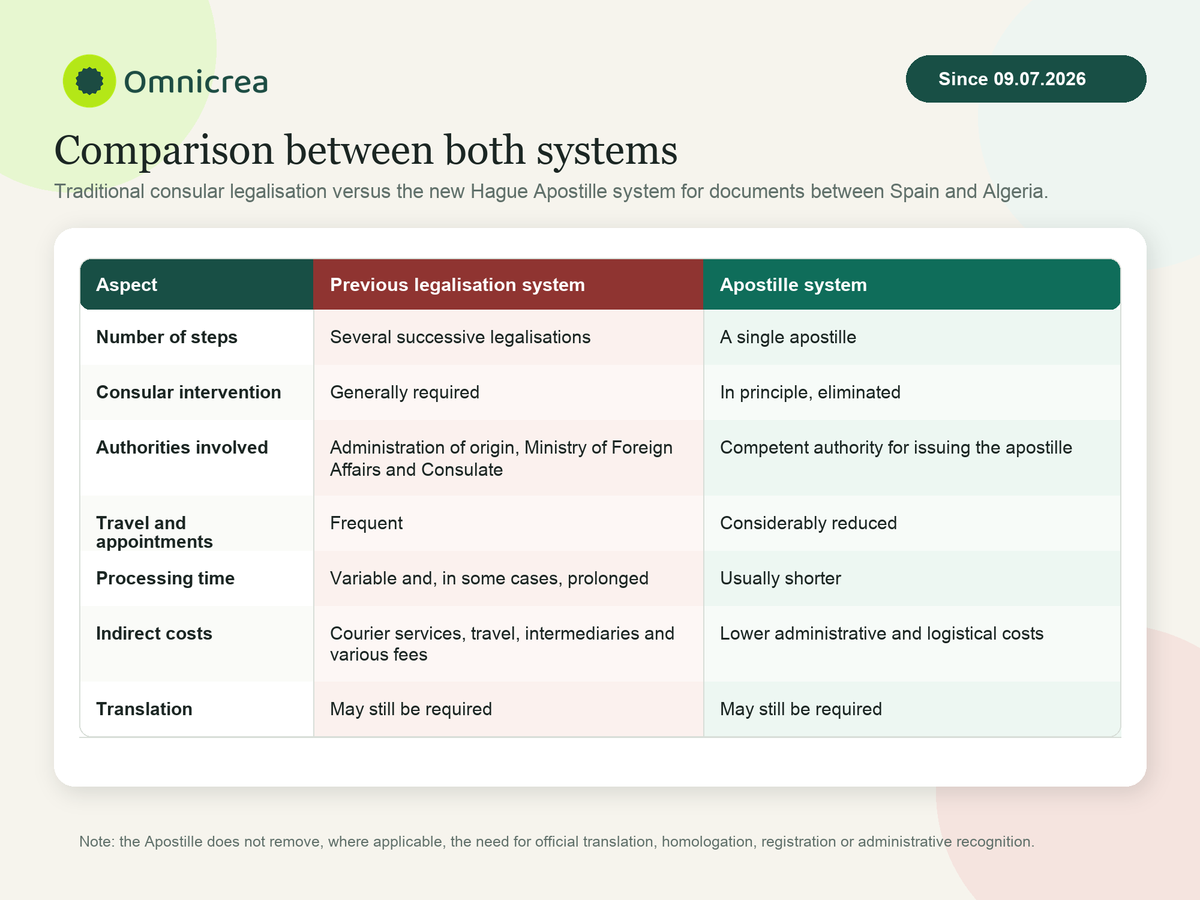
The apostille does not validate the substantive content of the document, nor does it replace an official translation where one is required. Its purpose is to prevent the document from having to go through a chain of administrative, diplomatic and consular legalisations.
The Convention generally applies to public documents such as civil registry certificates, notarial documents, court decisions, administrative certificates, degrees and certain academic documents, among others.
The previous procedure: a chain of legalisations
Until the Convention entered into force, the international use of documents between Spain and Algeria normally required a diplomatic or consular legalisation procedure.
To use a document issued in Algeria in Spain
- Obtain the original document from the competent Algerian administration.
- Complete the prior authentications required according to the type of document.
- Legalise it before the Algerian Ministry of Foreign Affairs.
- Submit it afterwards for legalisation by the competent Spanish diplomatic or consular representation.
- Obtain, where necessary, a sworn translation into Spanish.
To use a document issued in Spain in Algeria
- Obtain the Spanish public document.
- Complete the corresponding internal legalisations or prior certifications.
- Legalise it before the Spanish Ministry of Foreign Affairs.
- Legalise it afterwards before the Consulate of Algeria.
- Obtain a translation into Arabic or French where required by the receiving authority.
This system required coordination between several administrations, appointments, travel and different management, legalisation, courier and representation costs.
The new procedure: a single apostille
Since 9 July 2026, diplomatic or consular legalisation has been replaced, within the scope of the Convention, by a single certification: the Hague Apostille.
- The public document is obtained.
- The apostille is requested from the competent authority of the State that issued the document.
- The apostilled document may be presented in the destination State without the need for additional consular legalisation.
- The corresponding translation is attached where necessary.
Comparison between both systems
Which documents can benefit from the apostille?
- Birth, marriage and death certificates.
- Criminal record certificates.
- Deeds and notarial documents.
- Powers of attorney.
- Court decisions and judicial documents.
- Administrative certificates.
- Public degrees, diplomas and academic certificates.
- Commercial certificates and documents issued by public registers.
Before starting any procedure, it is advisable to check the specific nature of the document, the authority that issued it and the requirements of the body before which it will be submitted.
Certain commercial or customs documents may fall outside the scope of the Convention. In addition, the apostille does not remove requirements relating to translation, homologation, academic equivalence, registry inscription or administrative recognition that may apply in each case.
Special relevance for commercial relations between Spain and Algeria
- Incorporation of companies and opening of branches.
- Granting powers of attorney to representatives, lawyers or distributors.
- Participation in tenders and public procurement procedures.
- Submission of commercial certificates.
- Accreditation of directors and legal representatives.
- International hiring of workers.
- Recognition of academic and professional documentation.
- Investment operations and asset acquisitions.
- Judicial, arbitration and administrative proceedings.
- Immigration and international mobility procedures.
Less time, lower costs and greater legal certainty
The main advantage of the new system is clear: a chain of legalisations is replaced by a single apostille issued in the country of origin of the document.
- Reduction of processing times.
- General elimination of consular legalisation.
- Fewer in-person visits and administrative steps.
- Reduction of administrative, logistical and intermediary costs.
- Greater predictability in international operations.
- Easier submission of documents before authorities, banks, companies and public bodies.
Advice between Spain and Algeria
Omnicrea Consultoría, from its two main offices in Valencia and Algiers, advises companies and individuals on the preparation, review and processing of documentation intended to produce effects in Spain, Algeria and other international markets.
- Determining whether a document can be apostilled.
- Identifying the competent authority.
- Coordinating its obtainment and apostille.
- Reviewing the necessary translations.
- Checking the requirements of the receiving body.
- Planning the documentation for commercial, corporate, administrative or investment operations.
The entry into force of the Hague Apostille represents an opportunity to streamline economic and administrative relations between Spain and Algeria. Omnicrea Consultoría can advise and support you throughout the entire process.